
Why Small Jewelry Businesses Absorb Tariffs While Big Brands Pass Them On


Small jewelry businesses absorb tariffs because they cannot afford to lose customers over a price increase of even a few dollars, while large brands have the market dominance and customer loyalty to pass those costs along without flinching. When a new tariff hits imported metals, gemstones, or finished pieces, a company like Tiffany or Pandora adjusts its retail price and moves on. A small jewelry seller running an independent shop faces a harder calculation — raise prices and risk losing the handful of loyal buyers who keep the lights on, or eat the cost and accept thinner margins. Most choose the latter.
This difference is not just about size. It reflects fundamentally different business models, customer relationships, and risk tolerances. According to the International Trade Administration, tariffs on jewelry imports have shifted multiple times in recent years, and each shift ripples through the supply chain differently depending on where you sit. For small jewelry businesses sourcing stainless steel, sterling silver, or gold plated pieces from overseas manufacturers, even a five percent tariff increase can wipe out the profit on an entire product line. This article breaks down why this gap exists, what it means for the pieces you buy, and how independent sellers are finding ways to stay competitive without cutting quality.
Explore our collection of handpicked jade jewelry at KartiKart — minimalist pieces built to last.
Table of Contents
- Why Do Small Jewelry Businesses Bear the Cost of Tariffs Instead of Raising Prices?
- The Hidden Mechanics of Jewelry Tariffs and Who Actually Pays
- How Small Jewelry Sellers Protect Their Margins Without Sacrificing Quality
- What Shoppers Should Know Before Blaming Price Increases on Tariffs
- When Tariff Absorption Becomes Unsustainable for Independent Sellers
- How Material Choices Help Small Jewelry Brands Navigate Trade Policy
- Where Tariff Policy and Small Jewelry Businesses Are Headed
- Conclusion
Why Do Small Jewelry Businesses Bear the Cost of Tariffs Instead of Raising Prices?
The short answer is pricing psychology. A small jewelry brand selling an 18K gold Plated Stainless Steel bracelet at thirty-eight dollars knows that bumping the price to forty-three dollars does not sound like much in isolation. But their customers are comparison shoppers.
They browse Etsy, Amazon, and independent shops side by side. A five-dollar increase makes a small jewelry listing look overpriced against competitors who have not adjusted yet, and once a customer scrolls past, they rarely come back. Large brands operate in a different reality.
Their customers are buying a name, an experience, and a status signal. A Cartier buyer is not cross-referencing prices on marketplace sites. Research from the Gemological Institute of America consistently shows that brand perception drives purchasing decisions in the luxury segment far more than raw price.
That insulation lets big brands treat tariff costs as a simple line item to pass through. Small jewelry businesses do not have that cushion. There is also the question of volume.
A large brand importing containers of finished jewelry can negotiate freight rates, tariff engineering strategies, and even lobby for exemptions. An independent seller importing two hundred pieces at a time has no leverage with customs brokers and no seat at the trade policy table.

The Hidden Mechanics of Jewelry Tariffs and Who Actually Pays
tariffs on jewelry are not applied uniformly. The rate depends on the material composition, the country of origin, and whether the piece is classified as finished goods or components. Stainless steel jewelry entering the United States from China, for example, can face different tariff schedules than sterling silver pieces from Thailand or gold plated items from South Korea.
The U.S. International Trade Commission’s Harmonized Tariff Schedule runs thousands of pages, and misclassifying a single product can mean the difference between a three percent duty and a fifteen percent duty. For small jewelry businesses without a dedicated import specialist, navigating this system is a cost in itself.
Many end up overpaying tariffs simply because they lack the expertise to classify their products optimally. Larger companies employ entire compliance departments whose job is to minimize duty exposure through legal tariff engineering — reclassifying materials, shifting assembly locations, or splitting shipments strategically. However, if your supplier changes the composition of a piece — swapping a component from one alloy to another without updating the paperwork — even a well-prepared small business can get hit with unexpected duties at the border.
This is not theoretical. It happens regularly and can turn a profitable shipment into a loss overnight.
How Small Jewelry Sellers Protect Their Margins Without Sacrificing Quality
The most common strategy is not cutting corners on the product itself but cutting everywhere else. Small jewelry businesses reduce packaging costs, handle their own photography, write their own product descriptions, and skip paid advertising in favor of organic social media. The product stays the same.
Everything around it gets leaner. Another approach is shifting to materials that carry lower tariff exposure. 18K Gold Plated Stainless Steel, for instance, often falls into a more favorable tariff classification than solid gold or even gold filled alternatives.
The stainless steel base keeps the duty rate lower while the gold plating delivers the look and feel customers want. This is not a compromise — modern plating technology produces pieces that are visually identical to solid gold, with the added benefit of being lightweight, durable, and easy to maintain. Some small jewelry sellers also consolidate orders to reduce per-unit shipping and brokerage fees.
Instead of importing monthly, they buy quarterly in larger batches. This ties up more cash upfront but spreads the fixed costs of tariffs and freight across more pieces, effectively lowering the landed cost per item.

What Shoppers Should Know Before Blaming Price Increases on Tariffs
When a large brand raises prices and cites tariffs as the reason, it is worth asking whether the increase is proportional. A ten percent tariff on a component that represents twenty percent of a product’s cost should translate to roughly a two percent retail price increase. If the retail price jumps eight or ten percent, the tariff is being used as cover for a broader margin expansion.
This happens more often than most shoppers realize. Small jewelry businesses rarely have this option. Their customers are more price-sensitive, more informed, and more willing to switch.
An independent shop raising prices has to justify every dollar to a customer base that expects transparency. The tradeoff is real — a small seller absorbing tariffs keeps prices stable but may have less budget for things like faster shipping, elaborate packaging, or frequent new releases. For the buyer, this means that shopping from a small jewelry brand during a tariff cycle often gets you better value than shopping from a large brand that has padded its increase.
The product quality does not change based on who absorbed the tariff. The math just works differently.
When Tariff Absorption Becomes Unsustainable for Independent Sellers
There is a breaking point. A small jewelry business can absorb a three to five percent tariff increase on most products without existential risk. But when tariffs escalate to fifteen or twenty-five percent — as they did during certain phases of the U.S.-China trade disputes — the math stops working.
At that level, a seller importing pieces with a forty percent markup is now making almost nothing after tariffs, shipping, platform fees, and payment processing. The warning sign for customers is when a favorite small brand suddenly drops certain product lines, reduces its catalog, or quietly stops restocking popular items. That is usually not a branding decision.
It is a margin decision. The tariff made that specific product unprofitable, and the seller could not raise the price without losing sales. Sellers in this position face a difficult choice: pivot to domestic or tariff-exempt sourcing, raise prices and accept lower volume, or exit the category entirely.
Each option has consequences, and none of them are easy for a business running on thin margins and personal savings.
How Material Choices Help Small Jewelry Brands Navigate Trade Policy
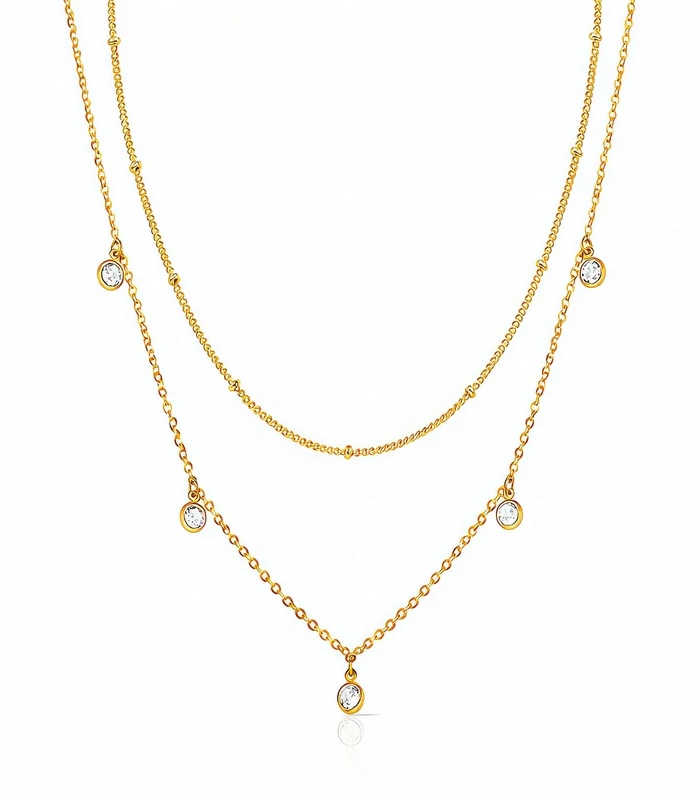
Choosing materials strategically is one of the most effective tools a small jewelry brand has against tariff volatility. Stainless steel, for example, is widely produced across multiple countries, which means a seller can shift sourcing without redesigning the entire product. If tariffs spike on imports from one country, the same 18K Gold Plated Stainless Steel piece can often be sourced from a manufacturer in a different region at a comparable quality level.
This flexibility is harder to replicate with precious metals or rare gemstones, where sourcing is concentrated in a few countries and switching suppliers means accepting different quality standards. For a small jewelry business building a collection around accessible luxury — pieces that look and feel premium without the premium price tag — stainless steel and gold plated options offer both style and supply chain resilience.
Where Tariff Policy and Small Jewelry Businesses Are Headed
Trade policy is cyclical, and the businesses that survive tariff cycles are the ones that build flexibility into their operations rather than optimizing for one specific trade environment. Small jewelry businesses that diversified their sourcing, invested in direct-to-consumer channels, and chose materials with broad availability are better positioned for whatever comes next. The growing consumer preference for independent and small jewelry brands also works in sellers’ favor.
Shoppers increasingly understand that buying from a small business means supporting someone who is absorbing costs that a corporation would simply pass along. That awareness does not eliminate the financial pressure, but it does create a customer base that values the relationship enough to stay even when prices do eventually need to adjust.
Looking for minimalist jade jewelry? Browse our full collection of necklaces, bracelets, earrings, and rings at KartiKart. Free shipping on all US orders.
Conclusion
The tariff gap between small jewelry businesses and large brands comes down to leverage, pricing power, and customer dynamics. Big brands pass costs through because they can. Small sellers absorb them because they must.
The materials, the craftsmanship, and the quality of the final piece are not determined by who paid the tariff — they are determined by the standards the seller holds regardless of margin pressure. If you are shopping for jewelry and wondering why your favorite independent brand has not raised prices while department store cases show new tags every season, now you know. Supporting small jewelry businesses during volatile trade periods is not charity. It is recognizing that you are getting the same quality, often better service, and a price that someone personally decided to protect — even when it cost them to do so.