Why White Jade Was Worth More Than Gold on the Ancient Silk Road

White jade commanded a status above gold in ancient China because it carried something gold never could — moral authority. While gold was valued across the ancient world primarily for its material worth, white jade was elevated to a spiritual and philosophical symbol so powerful that Confucius himself ascribed eleven virtues to the stone, including benevolence, righteousness, loyalty, and truth. The Chinese proverb “gold has a price, but jade is priceless” (黄金有价玉无价) was not poetic exaggeration. It was a statement of cultural fact that shaped trade, law, and imperial power for thousands of years. The reverence was not abstract.
During the Western Zhou dynasty, strict regulations controlled who could possess jade based on its quality and color. Only rulers were permitted to use the finest white jade from Hotan — everyone else was restricted to common varieties. That kind of legal framework never existed for gold. And the economics have followed suit into the modern era: in 2007, top-grade Hotan white jade quadrupled in value in a single year to roughly 10,000 yuan per gram, about forty times the price of gold at the time. Today, premium pieces can command $2,000 to $10,000 or more per gram. This article traces the origins of white jade’s extraordinary value along the Silk Road, the Confucian philosophy that elevated it above all other materials, the imperial systems that protected its supply, and what the rarest grade — “mutton fat” jade — still means in the gemstone world today.
Explore our collection of handpicked jade jewelry at KartiKart — minimalist pieces built to last.
Table of Contents
- Why Was White Jade Worth More Than Gold on the Ancient Silk Road?
- The Confucian Code That Made Jade a Symbol of Virtue
- How White Jade Became an Imperial Obsession
- Understanding “Mutton Fat” Jade — The Rarest Grade
- The Surprising Age of the Jade Trade
- What Jade’s Legacy Means for How We Value Jewelry Today
- White Jade in the Modern Gemstone Market
- Conclusion
Why Was White Jade Worth More Than Gold on the Ancient Silk Road?
The answer begins not with economics but with philosophy. In ancient chinese culture, gold simply did not sit at the top of the material hierarchy. The highest compliment you could pay a person was to compare them to jade — never to gold.
This was because jade carried a moral framework codified by Confucius that encompassed eleven virtues: benevolence, intelligence, righteousness, propriety, music, loyalty, good faith, heaven, earth, virtue, and the path of truth and duty. Gold had no equivalent symbolic weight. It was simply a metal with a market price.
This cultural hierarchy had direct consequences for trade. The southern route of what we now call the Silk Road — running from Khotan in modern Xinjiang to eastern China — was originally a jade route, not a silk route. Jade was traded along this path as early as 5,000 BCE, making it one of the oldest continuously traded luxury goods in human history.
By around 1200 BCE, white jade was traveling from Khotan to Anyang, the Shang dynasty capital in Henan Province. Khotanese jade has been found in Chinese tombs dating back over three thousand years. The two rivers near Khotan are literally named for the stone: the Yurungkash, meaning “White Jade” in Uyghur, and the Karakash, meaning “Black Jade.” When a landscape is named after a gemstone rather than the other way around, that tells you something about which one the people considered more permanent.

The Confucian Code That Made Jade a Symbol of Virtue
Confucius did not simply admire jade. He built it into his ethical system. Each of the eleven virtues he ascribed to the stone corresponded to a physical quality — its warmth to the touch represented benevolence, its translucency symbolized honesty, its hardness stood for intelligence.
Wearing jade was not decoration. It was a public declaration of your character and moral aspiration. This is a distinction worth understanding because it explains why jade could not simply be replaced by another beautiful stone.
However, this symbolic system applied specifically to nephrite jade within Chinese philosophical tradition. Other cultures along the Silk Road valued jade for different reasons — as a trade commodity, a diplomatic gift, or a status marker — but they did not necessarily attach the same Confucian moral weight. The philosophical premium was strongest within China itself, which is why the demand that drove prices above gold originated there rather than from Western traders.
It is also worth noting that not all jade carried equal virtue. White jade from Hotan was considered the highest expression of these qualities. Jade from other sources or in other colors held lower status.
The virtue framework created a quality hierarchy within jade itself that mirrored the social hierarchy of the empire.
How White Jade Became an Imperial Obsession
The Kingdom of Khotan sent yearly tribute shipments of white jade to the Chinese Imperial Court, where master artisans carved it into ceremonial objects, royal seals, and symbols of authority. This was not casual trade. The Han dynasty stationed military garrisons at Khotan specifically to protect the jade supply route — the same kind of strategic resource protection that nations today extend to oil fields and rare earth mineral deposits.
emperors and nobles wore jade to demonstrate both authority and virtue simultaneously. A jade seal was not merely a tool for stamping documents. It was a statement that the ruler possessed the moral qualities the stone represented.
Royal swords were fitted with jade. Ceremonial vessels were carved from it. The material was so tightly controlled during the Western Zhou dynasty that using white Hotan jade without the proper rank was a violation of law, not just social convention.
This imperial demand created a feedback loop. Because the court consumed enormous quantities of the finest white jade, supply remained constrained, which kept prices elevated, which reinforced the perception that the stone was extraordinarily precious. Gold, by contrast, was more widely accessible and carried no comparable restrictions on ownership.
Understanding “Mutton Fat” Jade — The Rarest Grade
Not all white jade is equal, and understanding the grading is essential for anyone interested in gemstones. The most prized variety is called “mutton fat” jade (羊脂白玉) — a warm, creamy white with a subtle translucency that resembles, as the name suggests, rendered animal fat. Only about five percent of all Hetian jade qualifies for this grade.
The combination of color purity, translucency, and texture required is exceptionally rare. The modern market reflects this ancient reverence. Premium Hetian white jade currently commands $2,000 to $10,000 or more per gram, with annual value increases in the range of twenty to thirty percent.
In 2014, a mutton fat jade seal sold for $1.24 million at Sotheby’s. These are not speculative prices driven by hype — they are sustained by a continuous cultural demand stretching back millennia. However, the market also carries risk.
Jade is one of the most frequently imitated gemstones in history. A 2025 study published in Scientific Reports confirmed that glass imitations of jade were produced along the ancient Silk Road itself, demonstrating that counterfeiting jade is not a modern problem. If you are purchasing jade, particularly anything marketed as Hetian or mutton fat grade, authentication by a qualified gemologist is not optional — it is essential.
The Surprising Age of the Jade Trade
Most people assume the Silk Road was primarily about silk, spices, and eventually paper. But jade predates all of them on the route. Chinese carvers in the Xinglongwa and Chahai cultures were working with Khotan jade as early as 5,000 BCE — roughly two thousand years before the earliest known silk production.
Neolithic jade carving, particularly in the Hongshan and Liangzhu cultures between approximately 3500 and 2000 BCE, produced sacrificial and ritual objects that survive in museum collections today. Khotan was possibly supplying nephrite to China as early as 645 BCE according to historical records, though the archaeological evidence of jade in Chinese tombs stretches back over three thousand years. This makes jade arguably the oldest continuously traded luxury commodity in the world — a claim that neither silk, gold, nor any spice can match.
One limitation of the historical record is that jade does not decay, so archaeological finds may overrepresent its presence relative to organic trade goods that disintegrated over the centuries. Still, the sheer volume and geographic spread of jade artifacts along the Silk Road corridor leaves no doubt about its central role in ancient commerce.
What Jade’s Legacy Means for How We Value Jewelry Today
The story of white jade on the Silk Road is ultimately a story about what makes something precious. Gold derived its value from scarcity and physical properties — it does not tarnish, it is malleable, it is universally recognizable. Jade derived its value from meaning.
It was precious because an entire civilization decided it represented the best qualities a person could aspire to. Both forms of value are real, but they operate differently. This distinction still matters when choosing jewelry today.
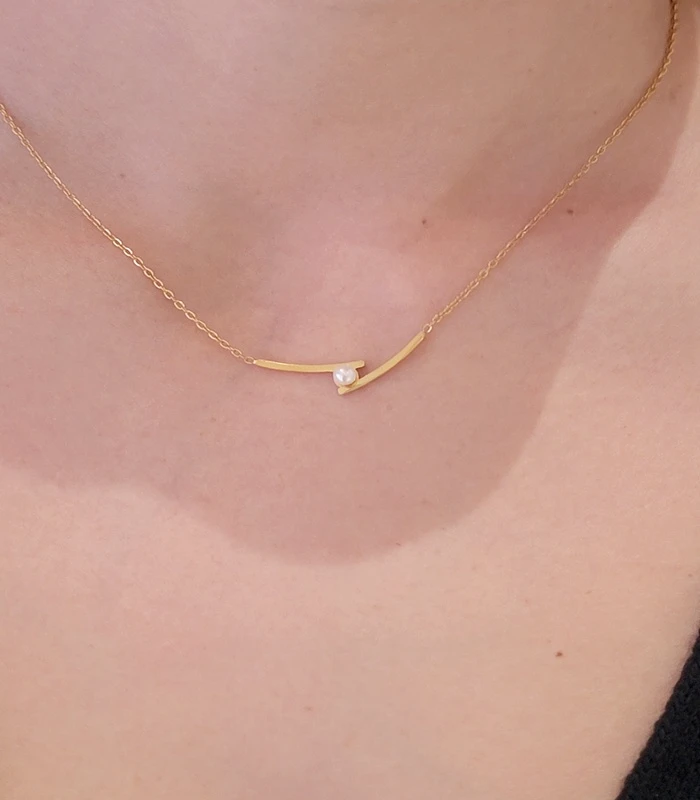
A piece does not need to be made from the most expensive raw material to carry significance. Modern 18K gold plated stainless steel, for example, delivers the warmth and elegance of gold with the durability of surgical-grade steel underneath — making it practical for everyday wear while still looking refined. The ancient Chinese understood that value comes from what a piece represents and how it makes you feel, not just from the market price of its raw components.
White Jade in the Modern Gemstone Market
The white jade market continues to grow, driven by sustained demand in China and increasing awareness among international collectors. With annual value increases of twenty to thirty percent for top-grade Hetian nephrite, white jade has outperformed most conventional investments over the past two decades. But this growth has also attracted sophisticated counterfeiting operations, making provenance documentation and professional certification more important than ever.
For those drawn to jade’s meaning rather than its investment potential, the Confucian virtues it represents — benevolence, loyalty, honesty, integrity — remain as relevant as they were twenty-five centuries ago. The stone’s enduring appeal is proof that the most lasting value in jewelry has always been about more than material cost.
Looking for minimalist jade jewelry? Browse our full collection of necklaces, bracelets, earrings, and rings at KartiKart. Free shipping on all US orders.
Conclusion
White jade outranked gold on the ancient Silk Road because it carried an entire moral philosophy within its translucent surface. Confucius gave it eleven virtues. Emperors restricted its use by law. Armies were stationed to protect its supply routes.
And the proverb held true for millennia: gold has a price, but jade is priceless. From 5,000 BCE to the present day, no other gemstone has maintained such an unbroken chain of cultural reverence. Whether you collect jade, wear gold, or choose modern alternatives like gold plated stainless steel for everyday elegance, the lesson from the Silk Road is clear. The most valuable jewelry is the piece that means something to you — the one you reach for every morning, the one that feels like an extension of who you are. That is what the ancient Chinese understood about jade, and it is still the best guide for building a jewelry collection that lasts.